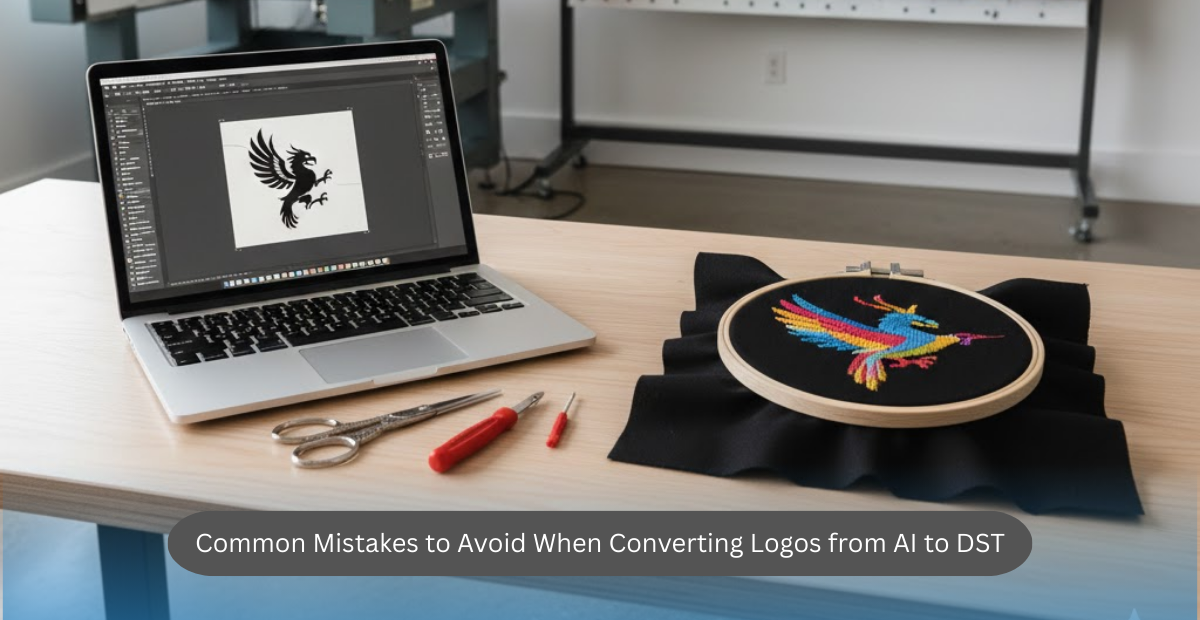
Converting logos from AI (Adobe Illustrator) to DST (distrained of a He is a popular embroidery file format) is a common task in enterprises working in the industry of custom apparel and promotional products. However, while this process may appear simple, there are ways to easily make mistakes that could have an impact on the quality and accuracy of the finished piece of embroidery. By the way, I want to pay attention to energy efficiency, because if you are trying to achieve the best results while converting AI logos into DST files, you may encounter several common pitfalls, to which you should be attentive.
At SBS Digit, we are into the business of providing high-quality embroidery digitizing services and free embroidery digitizing in the USA. Let’s get into the details of converting AI to DST and the most common mistakes to avoid.
1. Choosing the Wrong File Format
Embroidery and outgoing file format. One of the biggest mistakes that many people make is not trying to understand the importance of file formats when digitizing for embroidery. While AI files are the type used for the vector of editing and are preferable for the design work to be done, DST files for embroidery use a different purpose. The new DST file format is made especially for embroidery machines, where the information regarding the stitches is contained within the file.
Why it’s a mistake: AI files contain information like colors, layers, and paths, but they don’t contain the stitch data that embroidery machines need to follow. This means that if you try to use a file of an AI file to do embroidery, the file will not be properly translated.
Solution: You can transform the file of AI to the DST file format using a good DST converter. It’s very important that the conversion software or service you use is able to accurately interpret your design, not just the visual elements of the design.
Tip: The next question that may arise in your mind is how to create a DST file? The answer is in the form of proper digitizing software, which will convert the visual design to machine-readable stitch data.
2. Not Paying Attention to the Density of the Stitches
The stitch density is the term used when referring to the proximity of the stitches within the embroidery file. When converting a logo with AI to DST, the optimal stitch density has to be applied so that there are no puckering or areas between stitches in the design.
Why it’s a mistake: If you are stitching too tightly (high density), it will make your fabric pucker or distort. If they are too loose the overall effect of the embroidery will be sparse, and details may be lost.
Solution: If you are using a DST embroidery file, always check the stitch density in it. Some DST file converters will automatically adjust stitch density, but it’s always a good practice and necessary to double-check and adjust when necessary.
3. Neglecting Thread Colors and Fabric Types
While possibly AI files could contain standard color codes, embroidery machines use specific thread colors. Simply changing a PNG file to a DST file or any other graphic to a DST file, without considering the thread colors and the fabric types, may give poor results.
Why this is a mistake: The type of fabric can be as important as the type of garment in terms of the thread used, and sometimes different colors of threads will not be available or won’t look the same on the fabric.
Solution: Make sure that when converting AI files to DST, you select thread colors that would be workable with the material that you are working with. Many DST file format converter allows you to choose from the thread of a given brand, such as the Madeira thread or the Acord thread, so be sure to modify accordingly the color palette.
4. Skipping Manual Adjustments After Conversion
Using an automatic DST converter may be a convenient way of solving the issue, but sometimes, it does not calculate adequately to take into account some of the minor design tweaks that will make or break your embroidery. For example, closed text or very detailed design elements may not translate well in AI to DST, and may result in disappointing translated design.
Why it’s a mistake: Even though DST file converters can come in handy, they’re not always accurate and high-quality enough to produce desirable results. The fine elements, like thin lines, small text, and gradients, are not going to translate quite like that.
Solution: When you get your AI design turned into a DST file type, don’t forget to spend some time improving the result. Manual compensation through stitch path adjustments, underlay, and/or shrinking of fabric will make a huge difference in the outcome.
5. Not Testing the Design Before Signing Off
One of the best ways of avoiding costly errors in the embroidery process is by testing the DST file out on a sample of the fabric before going through with the production run. Many businesses do not test their design before they start to move on, assuming they can get perfect results from the conversion process.
Why it’s a mistake: Not doing a proper test stitch-out takes place, you will not know how the design will look on the fabric. Defects such as stitch quality, alignment, and thread-tension matters can only be detected during testing.
Solution: Always convert your file to DST and do a test embroidery to be sure that everything goes well. Should there be any problems, such as thread breakages and errors with the thread’s position, you can tinker in the DST file before the final production.
6. Overlooking the Complexity of the Design
Sometimes, the designers of the AI include way too much information, or it is too complex for embroidery. If your logo has small text or fine lines, these items are probably difficult to copy using embroidery stitches.
Why it’s a mistake: The DST files for embroidery are to be simple, and the representation of the design. Intricate details such as small text or gradients might fail to retain well in the DST extension, especially when the logo is scaled down in size.
Solution: Where possible, try to simplify your design and then convert it to DST. Perform on garbage contractions by removing any unnecessary details that will not show well on fabric. If you are required to retain those details, make sure that you have a DST file converter that will allow you to manually adjust stitch types and parameters to get the best results.
7. Not Using the Right Software
Sometimes, when you’re working with AI files and converting them to DST, using the right software can make all the difference. There are different DST file type converters available, but not all are created equal to each other. Poor software can cause file errors, inferior conversions, or important details may not be saved.
Why it’s a mistake: Hunger for robes to cheap or unreliable software, which is not ready to perform conversion, so logically distorted designs, unreadable embossing files.
Solution: Invest in a trusted and quality embroidery software such as SBS Digit’s embroidery digitizing services in DST file. This makes sure that your design is handled professionally from beginning to end.
8. Not Converting Correctly (AI to DST)
This may sound obvious, but neglecting artwork conversion from an AI file to a DST file may cause unsatisfactory results. Apis has hours, bicycles, chickens to DST as a riddle means cut stitching, not best manual identical AI manufacturing unsuitable file dart to embroidering machines.
Why it’s a mistake: Failing to use the correct conversion method can create unreadable DST files or stitches that don’t match properly.
Solution: Make sure that you’re using a reliable DST converter that sees to it that there will be a high-quality conversion. Look for alternatives that provide the free DST file conversion capability to be able to try the process without paying for additional costs.
Final Thoughts
Converting logos from AI to DST files might appear to be an easy task, but there’s much to consider in order to produce the best results. If you avoid making common mistakes such as the improper file format selection, skipping the test runs, thread colors, etc., then you can have a beautiful logo as soon as it is embroidered.
If you need expert help in converting AI files to DST, then SBS Digit is offering top-notch embroidery digitizing services, Bad relic embroidery digitizing free in the USA. We’re here to help you create high-quality DST files for embroidery, ensuring your logo looks fantastic on any garment.